
Early this past June, my granddaughter told me that, before seeing the movie of the Odyssey, which was coming out later in the summer, she wanted to read it. So I suggested we read it together—using what I think is the best translation: Emily Wilson’s of 2018.
Since my granddaughter is a working woman and I’m retired, I let her decide how much we should read each week (usually it was four to six Books). Then each Sunday we zoomed to discuss the week’s reading. We had such fun that, when we’d gotten to the end, she said we should now read the Iliad together. Which we did. But for this post I want to stay with the Odyssey.
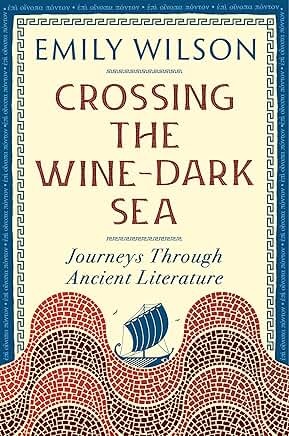
Because recently my sister alerted me to Emily Wilson’s new book of essays: Crossing the Wine-Dark Sea: Journeys through Ancient Literature. (Yes, reading is a family affair.) Naturally I went right to the library to get it. The essays cover Sappho, Catullus, Aeschylus, and more. But naturally (again) I turned first to the one called “Translating the Odyssey.”
It’s a long essay (sixty pages) and ambitious: Wilson’s purpose is to choose a few passages from the poem and follow each through several or sometimes all of its English translations, beginning with Chapman’s of 1616 and ending with her own. Altogether she chooses five passages, but I can focus here on just one. I’ll take the passage she ends her essay with: the Odyssey’s opening, comprising ten lines in the Greek original. (The Greek, by the way, is in dactylic hexameter.)
To give you a sense of this passage, here is Wilson’s translation (though I won’t be discussing it till the end):
Tell me about a complicated man.
Muse, tell me how he wandered and was lost
when he had wrecked the holy town of Troy,
and where he went, and who he met, the pain
he suffered on the sea, and how he worked
to save his life and bring his men back home.
He failed, and for their own mistakes, they died.
They ate the Sun God’s cattle, and the god
kept them from home. Now goddess, child of Zeus,
tell the old story for our modern times.
Find the beginning.
For this passage, Wilson chooses only “some of the most widely read modern translations.” She starts with a prose version: Peter Jones’s 1991 revision of E. V. Rieu’s 1946 one. It begins: “Tell me, Muse, the story of that resourceful man who was driven to wander far and wide…” Wilson likes their “resourceful” for the Greek polytropon, though “it conveys nothing of the original’s implicit metaphor of turning and being turned.” And while “the original has just three words for Odysseus’s wanderings… Rieu has eight: “who was driven to wander far and wide.” (This is Wilson’s frequent complaint about translations: their wordiness. She tells us in her Translator’s Note to her own translation that “My version is the same length as the original, with exactly the same number of lines.”)
She moves next to Richard Lattimore’s free verse translation, which “is even more verbose”: the original’s seventy-four words become 109. He “adds repetitions where the original has none.” And “the awkwardness of phrasing and strange lack of fluency give a very different overall impression than does the vivid, rhythmical language of the original.”
Next: “Daniel Mendelsohn’s 2025 translation begins, ‘Tell me the tale of a man, Muse, who had so many roundabout ways / to wander, driven off course, after sacking Troy’s hallowed keep.’ Fourteen words in Greek have become twenty-four in English, through the addition of words and phrases that correspond to nothing specific in the Greek.”
Then she moves to Robert Fitzgerald’s 1961 version (the one I’d always read before Wilson’s appeared). Here it is in full:
Sing in me, Muse, and through me tell the story
of that man skilled in all ways of contending,
the wanderer, harried for years of end,
after he plundered the stronghold
on the proud height of Troy.
He saw the townlands
and learned the minds of many distant men,
and weathered many bitter nights and days
in his deep heart at sea, while he found only
to save his life, to bring his shipmates home.
But not by will nor valor could he save them,
for their own recklessness destroyed them all—
children and fools, they killed and feasted on
the cattle of Lord Helios, the Sun,
and he who moves all day through heaven
took from their eyes the dawn of their return.
Of these adventures, Muse, daughter of Zeus,
tell us in our time, lift the great song again.
Wilson notes that Fitzgerald’s translation is “far more elegant” than previous ones, and written in “a largely iambic rhythm” (as is hers). Her commentary continues: “Many of the most charming details of this translation are entirely the invention of the translator, including the lovely ‘in me … through me’, the ‘story’…, the ‘dawn’ of their return (rather than ‘day’), the notion that Odysseus could not save the men ‘by will nor valor’ … [and more, until] ‘lift the great song’ — a beautiful echo of the Hebrew psalms … imported into an entirely different ancient text.” So I’m hearing Wilson’s comments here as a sort of back-handed compliment: these charming details are unfaithful to the Greek original.
She continues along these lines, then ends: “I personally like Fitzgerald more than most of the modern British and American translations, because he is attuned to rhythm and the possibilities of the English language, in ways that many contemporary classicists are not. At the same time, the fine literary artifice—the clever, original phrasing and the dense allusions to earlier literature—are out of keeping with the oral poetics of the original.”
Wilson moves on to a couple more translators, but I’ll end now as Wilson herself does: on her own translation of this passage. A couple things strike me especially. One is that for this essay she has almost totally re-translated it: only the opening line—“Tell me about a complicated man”—appears in both this and her published translation. The other remarkable thing about her closing discussion is that she spends her essay’s final seven and a half pages parsing one word from this line: “complicated.” “Why,” she ponders, did the Odyssey’s poet “choose a relatively unusual epithet, polytropos‘much-turny’?” As for translating it, “I spent many hours, days and weeks searching for alternatives.” She then takes us through the many alternatives she considered and the reasons she rejected each. And she ends:
“Is ‘complicated’ exactly the same as polytropos? No, of course not. Does it correspond in a lot of important ways, and perform many of the same functions in the sentence and the verse paragraph? Yes. Can I think of a way to improve on it? After many years of pondering the question, I’d still say: no.
“If I live another twenty years, and retain the capacity to read, and if the world is still habitable by humans, I hope to see younger people come up with much better solutions than mine. I also suspect that we will have more important things to worry about by then.”
Peggy Rosenthal has a PhD in English Literature. Her first published book was Words and Values, a close reading of popular language. Since then she has published widely on the spirituality of poetry, in periodicals such as America, The Christian Century, and Image, and in books that can be found here.
Close Reading is now available on Substack, where you can sign up to receive all posts directly to your inbox. To learn more, click here.