Here’s Robert Frost’s poem “The Dust of Snow”:
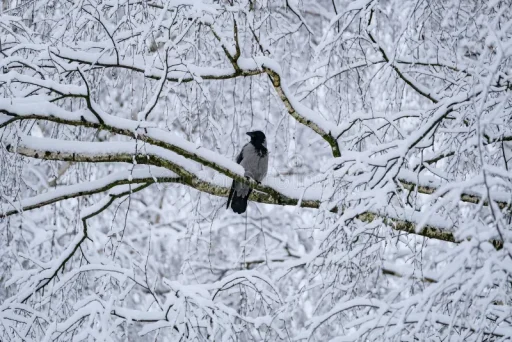
The way a crow
Shook down on me
The dust of snow
From a hemlock tree
Has given my heart
A change of mood
And saved some part
Of a day I had rued.
Out of curiosity I consulted what Wikipedia has to say about this poem, and can report that Wikipedia finds it a pretty much open book, just the right thing to help tenth-graders get over their presumed dislike of or aversion to poetry. The poem is mercifully short and, according to Wikipedia, yields itself willingly to analysis. The compact iambic lines are easy to scan, and the alternating end rhymes chime reassuringly. The iambs bend pleasingly into rippling anapests in lines 4, 5, and especially in the final line, line 8. And the poem doesn’t get complicated. It’s over almost before it begins. Just one sentence stretched comfortably and symmetrically between subject in the first quatrain and predicate in the second.
As for what the poem appears to “say,” Wikipedia’s answer seems to be: don’t take yourself so seriously. How bad can your problems be if one clever bird can play a trick that shakes you out of your bad mood? The poem becomes a kind of parable about how to relax. Go out for a walk in the woods after a snowfall! Not a bad lesson to teach a group of self-preoccupied adolescents.
I’m not disparaging an approach like Wikipedia’s to the poem, as I’ve used something like it myself when I used to teach tenth graders years ago. But only as an approach. You want students to feel at ease with what they’re reading, so that they can enjoy the poet’s artistry without worrying about being asked to pin down those lurking, nasty “deeper meanings” poets are said to hide in their poems like traps for the unwary. But the main thing you want is for students to be open to the ways poetry can do something far more interesting than plant “deeper meanings.” I’m speaking of poetry’s capacity to suggest mystery. All the better when poetry is able to do so in situations that seem on the surface simple, even banal. Case in point: the Frost poem in question.
The fun begins when you ask students, not about meanings, deep or otherwise, but about a poet’s choice of words. And specifically, in the poem “The Dust of Snow,” about the word “rued.” All the words are easy up to the very end. What does this last one mean? And why does Frost leave this word for very last?
First, its meaning: Some students will suggest “regretted,” basing their answer on context, for they admit they haven’t heard the word used before. Or maybe someone has heard the expression “you’ll rue the day…,” though only as a rather theatrical phrase to warn or scold, and never used conversationally, as if salvaged from a bit of dialogue from an ancient book or movie.
But then if you ask a student to look up the word’s meaning and background (yes, permission to use Google granted), the class learns that “rue” doesn’t just mean “regret,” but “bitterly regret,” coming from an Old English word for “cause contrition,” and from German Reue, “remorse.” So “rued” doesn’t suggest that the speaker has merely been having a “bad day,” or feeling self-preoccupied (though I’ll grant those can be hard moments for anyone). The speaker has been gripped by a very painful reaction to his or her own wrong-doing.
But what has the speaker done that has made him or her feel rueful? The poem’s mystery culminates right here, in this final word. We don’t know, and don’t find out. Yet the seriousness of the speaker’s state of mind now calls in question the situation itself, and, for starters, the agency of this crow. It’s as if the effect of “rued” works backward to reshape what’s preceded it. So looking back from “rued,” we no longer seem to be dealing with a cartoon crow, a little mischief maker executing a clever surprise on the moody dope trudging along below him, but a mysteriously wise searcher of souls carefully gauging the effect of a specific kind of wake-up call on a troubled spirit.
But what warrant do we have for imagining the crow as either the one or the other: either as trickster or spiritual guide? What about the apparent simplicity of the setup of this drama itself? The poet lays out its ordinariness carefully in the first quatrain, as if to accent the strangeness of what will happen in the second. We’re in not just any forest, but one full of hemlocks, a tree known for its fan-like spreads of tiny, feathery needles—a surface just right for a dusting of snow to gather upon. And very easy for a crow, lighting on one of its branches or taking off again, to “shake,” sending down snow dust below. On the one hand, the scene seems to have nothing mysterious or magical about it. But it also feels more mysterious for being so plain, so easily ascribed to mere chance.
So any “intention” we ascribe to the crow, whether for wit or wisdom, we carry out on our own responsibility. As for the poet, he’s noncommittal on this point. In line one he states that it’s the “way” the crow behaved that caused the change the poet describes in the second quatrain. But the question of what that “way” might be becomes harder to interpret in the light of what we learn in the second quatrain about its result.
But here too, and far more mysteriously still, we’re met with uncertainty, because the speaker’s reaction doesn’t involve an active response (surprise, indignation, or, alternatively, amusement) but a yielding one, an attitude of grateful acceptance. It “has given my heart a change of mood…,” and then as if in order to give a parallel version of what that “change” might have been, he adds, in summing up, “And saved some part / Of a day I had rued” — giving “rued” the final authority about where this poem was heading all along. But the pairing of results is itself a bit deceptive. A “change of mood” is usually an internal event, a shift of inner disposition easily tipped one way or the other. But “saved” implies a rescue, an intervention from outside or above that puts you on firm ground again. You could not have done it by yourself.
Yet even as the poem comes to its conclusion and a seemingly full disclosure of what the speaker has gained by his gift from the crow’s “way” of shaking down snow on him, the poet reveals yet another mystery: that this crow-inspired rescue saved just “some part” of that “rued” day, not the whole of it. Sure, we can ask, “But which part”? But we look in vain for the crow to return, sit on that hemlock branch again to shake down some more of that magic snow, in order for us to hear the whole story.
But there is no “whole story,” the poet is suggesting. Nor any “deeper meaning.” Instead, we’re left with questions. We’re left to wonder. We’re left with mystery.
After getting his PhD in English literature, George Dardess taught close reading to his own students until his retirement. Since then he has been ordained a Deacon in the Roman Catholic Church and written several books on Muslim-Christian relations. He has also created the graphic novel Foreign Exchange.
Close Reading is now available on Substack, where you can sign up to receive all posts directly to your inbox. To learn more, click here.