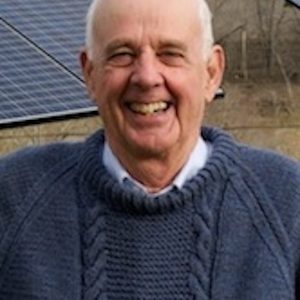

Scott Cairns’s latest poetry collection, Against Certainty, just published by Slant Books, is his twelfth book of poems. Cairns touches on many motifs in this new book—including “nous” (or the mind), travel, and his cancer. But for this post I want to focus on the major theme that runs through the collection: prayer.
The first poem in Against Certainty to consider prayer is “A Late Ambivalence Mid-Lent,” which begins:
I am increasingly ambivalent
     regarding the efficacy
of prayer, of prayer as petition,
     ambivalent regarding any
expectation of much beyond the sweet
     balm that saying the Name avails.
It’s interesting that this initial poem on prayer begins by questioning prayer’s “efficacy”—that all Cairns expects from saying God’s name is a “sweet balm.” And the poem’s next line adds the rhyming “calm”:
The calm I know each time that I descend
     into prayer is palpable,
sufficient, also wholly sufficient
     is that stillness I suspect when—
in saying the prayer—I find myself
     descending more deeply into
whatever it is I sense descending
     into me, filling me even
as I speak the Name into the darkness.
So here’s a paradox of his prayer: that in it he descends into what he senses “descending / into me.” And yet:
     I am becoming, just the same,
aware that none of those things for which I
     ever asked—over a lifetime
of what was relatively earnest prayer—
     have altered fraught appearances
one whit. Such awareness has now led me
     to suppose that petitions remain
far from the heart of prayer, and that prayer
     is for the most part simply one’s
entrance into the efficacious place
     where petition, whim, desire are eclipsed.
There could hardly by a stronger dismissal of the efficacy of petitionary prayers.
The book’s very next poem picks up “efficacy” in its title: “The Efficacy of Prayer.” Yet this efficacy is minimal, even slightly comic:
I speak only of my own, moot
and tepid prayer, the effects
of which are too subtle to show
here on my poor radar beyond
the random, brief, and fading blip.
“Even so,” he adds a bit later in the poem, “I do pray”—
but have become less fixed

on seeing what might come of it,
having become more profoundly
aware of a quieting, what
one might apprehend as a faint,
barely tasted sweetness received

as I sink into the stillness
that prayer—and only prayer—
occasions just here, here, where my
mostly anxious heart onetime let
a sudden pulsing calm overwhelm me.
So in his prayer he’s looking less for results than for a “quieting,” a faint “sweetness,” and— again—a “calm.”
In the poem that follows, “Barren Prayer,” Cairns’s priest tells him that his “apparently barren prayer”
                               may yet prove
     to be somewhat more pleasing to
the invisible and mostly
     unapparent God than any
utterance flowing from the rare
     superabundance of giddy
joy that I have too rarely known.…
I pray that he is not mistaken.
     I pray that he has found for me
a sorely needed consolation.
That “sorely needed consolation” becomes a “promise” later in the book, in the poem “Venetian Vespers”:
In my Eastern church, the vespers often
can acquire, in their language and their tone,
a keen sense of lament, an all but Lenten
sadness accompanied by a subtle,
latent joy—a modest joy attending
to the promise of our consolation
biding in the nous, where one might yet obtain
an uncommon calm, unassailable.
So, again, the desirable “calm” —along with the calming “l” sounds in “language…lament…Lenten…latent.”
But to return from this liturgical prayer to what Cairns finds are the challenges of his private prayer, we come next to “Another Idiot Psalm” (“another” because in 2014 Cairns published a whole book called Idiot Psalms). Here’s the poem’s opening stanza:
The Lord always hears. Of course, the Lord hears
whenever you speak to Him, and frankly
whenever you don’t. Should you feel you must
from Him receive an answer, all you need
do is to open your mouth, open your mouth
and speak. Lord, to you do I speak that I
may hope to hear your inobtrusive word.
I love here that God “hears” us even when we don’t speak. It’s reassuring, somehow.
Later in Against Certainty is the poem “My Poor Prayer,” with the epigraph Therefore, I say to you, whatever things you ask when you pray, believe that you receive them, and you will have them. —Mark 11:24. The poem begins:
I don’t know what one is to make
of such a thing—Christ’s saying such
a thing, suggesting that one’s sore
fickle belief bears agency
for altering a circumstance,
and our securing what we ask.
So, as in the previous poem, the issue is what it means for God to hear our prayers. Here, Cairns is doubtful that “one’s sore / fickle belief” could have “agency.” But then he blames his own “poor faith”:
Given some long experience
to the contrary, I cannot
but infer the problem to be
my poor faith yielding nought but fruit-
less prayer. Peace, for instance, how long
must one pray for peace to see it?
He’s hard on himself, blaming himself for his “fruitless prayer.” But in the book’s final poem on prayer, “Saint Simon’s Cave,” he does find consolation—though this time without using that word:
                                   My earnest prayers
over the past year had appeared to yield little,
though the act of prayer—the leaning in, the deep
calm of attending to The Presence—continued
to be a sorely needed balm, almost enough.
There’s that “calm” and “balm” again, from the first poem we looked at. They seem to be the most that Cairns can expect from his prayers.
Peggy Rosenthal has a PhD in English Literature. Her first published book was Words and Values, a close reading of popular language. Since then she has published widely on the spirituality of poetry, in periodicals such as America, The Christian Century, and Image, and in books that can be found here.
Close Reading is now available on Substack, where you can sign up to receive all posts directly to your inbox. To learn more, click here.