I have been on the move. I turned from my desk and took four steps to reach a bookshelf behind me. Once there, I slid a row of poetry books, organized alphabetically, and packed them in a box. I carried the thirty-pound box down two flights of stairs and then through the garage to the driveway, where I loaded the box of books into the back of my 2009 Prius. I had seventeen full bookcases. The new house into which we were preparing to move could accommodate seven bookcases. Which books to keep? Which to seek new homes for? In order to live comfortably in the new house, I had to narrow my sense of which books were essential for me to live.
Three days after movers delivered our furniture to the new house, we celebrated Rosh Hashanah, the Jewish New Year. Less than two weeks later, right after Yom Kippur, the Day of Atonement, we took off for two weeks of travel—Asheville to Santa Fe, Santa Fe to Los Angeles, Los Angeles to Coachella Valley, then back to Asheville. We traveled for events in relation to the publication of The Loneliest Monk, my fifth book. In a period of a few weeks, we moved from one house to another, from the old year to the new, from repentance to joy, Sukkot, the harvest festival of booths, from the east to the west and back.
Big moves.
Compared to these, a lyric poem seems to make small moves. Consider this line by Emily Dickinson:
I dwell in Possibility –
If you can attune yourself to the line, you will experience a brief, subtle, natural pause following the word “dwell.” “Dwell”: the sound of the word stretches out, sonically mirroring one meaning of “dwell”: “to remain for a time”. By comparison, the next six syllables—“in Possibility”—speed up. They take almost as much time to say as the first two syllables of the poem, “I dwell.” The line moves at two different speeds.
I remember reading this line after I had been practicing meditation regularly for a couple of years. At that time, this first line named an experience I had had, if only briefly, more than once since I had begun practicing: sitting still (dwelling) while sensations, including thoughts, kept arising and passing (possibility).
The second line moves in some new ways:
A fairer House than Prose –
In this second line, “dwell” moves on to another of its meanings: a place to live, “a fairer house.” Additionally, the poem now defines “possibility” metaphorically as a “house.” But not just any house. It’s the house of “Prose.” This directs our attention back to the first line, in which the dwelling place is “possibility,” now experienced as a characteristic of “Poetry.” That’s the house in which Dickinson dwells!
Metaphor moves. By its very nature, metaphor moves a reader from a metaphorical term to a literal term. In its ancient Greek root, the word “metaphor” means “a transfer” or “carrying across.” So, movement. So much movement in two short lines—three beats each—of the poem!
Two and a half miles: that’s how far my wife and I moved from a house where we had lived for twenty-one years to our new house. Over the two decades plus one year, in addition to books, we accumulated a lot of stuff. Now was the time to downsize. For a little more than two months as we approached moving day, my whole life felt downsized. No time to read. No time for friends. No time to exercise. No time for nostalgia. No time for a Sabbath. No time to dream. No time, no time for anything other than sorting, distributing, discarding, wrapping, packing, lifting, carrying. Rather than a long-lined Whitmanesque experience, my daily life felt more like a shorter, more tightly lined Dickinson poem.
How expansive can the moves made in a short poem be? Much of the remainder of Dickinson’s poem extends the metaphor of poetry as a house, noting its windows, doors, high ceilings, and roof as well as visitors to the house and the resident’s occupation. But what a house!
More numerous of Windows -
Superior - for Doors -

Of Chambers as the Cedars -
Impregnable of eye -
And for an everlasting Roof
The Gambrels of the Sky -
Our new house is modest. A ranch house built in 1969. But the houses in our new neighborhood? The breathtaking homes are enormous. Through the tall, wide windows we can peer into high-ceilinged rooms. That kind of architectural spaciousness: it’s real. Perhaps the architect who designed them was inspired by Dickinson’s poem. I wonder, though, if it might delude us into thinking that such spaciousness can’t also be experienced in tighter, narrower places: a house, a human heart and mind, a poem.
The poem concludes:
Of Visitors - the fairest -
For Occupation - This -
The spreading wide my narrow Hands
To gather Paradise -
Visually, the penultimate line is “wider” than every other line in the poem. Metrically, it’s longer. It stretches out to four beats. Its nearest relative in the poem is the third line of the second quatrain: “And for an everlasting Roof”. That line can be read as three or four beats. Either way, the earlier line moves much faster than “The spreading wide my narrow Hands”.
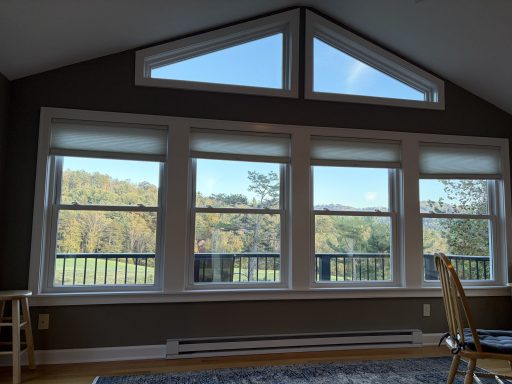
The view from our new house, in which we are still settling, is wide, expansive. The house sits above the 16th or 17th hole of a country club’s golf course. Every morning, from the sunroom at the back of the house, we watch fog in the “valley” of the golf course gradually dissipate and the sun rise over the closest ridge. Beyond that ridge, a majestic view of the Blue Ridge Mountains.
Before we moved, I was a restless reader. I jumped from book to book, reading a few pages of each, certain that what I really needed to read was one of the other books in my personal library. Since moving, I’ve been reading one book slowly. While my reading practice may have seemed to narrow, I think it’s actually deepened. Reading widely, which I once understood to mean reading books and essays on a wide range of topics, I now understand to mean the widening of my awareness, my intellect, my imagination, my heart as I dwell on one book. And there, with the book spread wide open in my hands, I gather paradise.
Richard Chess has published five books of poetry, the most recent of which is The Loneliest Monk. Professor emeritus from UNC Asheville, where he directed the Center for Jewish Studies for 30 years, he recently stepped down after five years of service on the board of Yetzirah: a Hearth for Jewish Poetry. You can find him at www.richardchess.com .
Close Reading is now available on Substack, where you can sign up to receive all posts directly to your inbox. To learn more, click here.